Future CoLab 3000
Turn AI ambition into workable adoption that creates value.
AI adoption is not only about selecting capable technology. It also depends on clear workflows, roles, decision responsibilities, governance and the capability of the people expected to use and supervise it.
This is where many initiatives begin to struggle. Tools, pilots or implementation can move ahead while the operating conditions around them remain unclear. AI increases that challenge because outputs can vary, influence judgement and create new questions about oversight and accountability.
Some organisations are still deciding where AI can make a practical difference. Others are preparing pilots, already implementing AI or trying to improve activity that is not producing the expected value.
Future CoLab 3000 works at the business adoption layer between leadership intent and operational reality.
That's the work: helping leaders and teams find where AI can create real value, keep human judgement and accountability where it needs to be, and build the pilots, capability and operating conditions that hold up as adoption grows.
The objective is not AI activity for its own sake. It is making AI useful, workable and accountable in the organisation.
About Andrew
For more than two decades, I have worked across business analysis, automation, transformation, process redesign, facilitation, capability development and organisational change.
That background matters because AI adoption is not only a technology problem.
It is also:
- a workflow problem
- a data problem
- a decision problem
- a governance problem
- a people problem
My career has been built around understanding how work actually operates, identifying what needs to change and turning complex problems into practical decisions and workable outcomes.
I now bring that experience to AI adoption.
How I work with you
I work with leaders and teams where AI is being considered, piloted, implemented or improved.
The work is practical and structured, connecting AI ambition to the realities of how the organisation operates.
The focus is on:
- finding where AI can create useful operational value
- aligning AI activity to real workflows and business needs
- establishing clear accountability, human oversight and operating conditions
- establishing where organisational data travels and which parties can reach it
- testing whether AI activity is creating enough value to justify its cost against the best alternative
- strengthening pilots and implementation as adoption progresses
- building the capability people need to use, manage and supervise AI effectively
Good controls are not there to slow adoption down. They help organisations move forward with greater confidence because responsibilities, boundaries and ways of responding to problems are clear.
What you achieve
The focus is on turning AI potential into practical organisational value.
Depending on where you start, the work can help you achieve:
- clearer direction on where AI can make a useful difference
- stronger alignment between AI investment and real operational needs
- more workable workflows, roles and accountability
- stronger pilots and better evidence about what is working
- clearer capability requirements and greater confidence about what to strengthen, expand, change, pause or stop
The result is AI adoption that is better connected to the work and better positioned to produce useful outcomes.

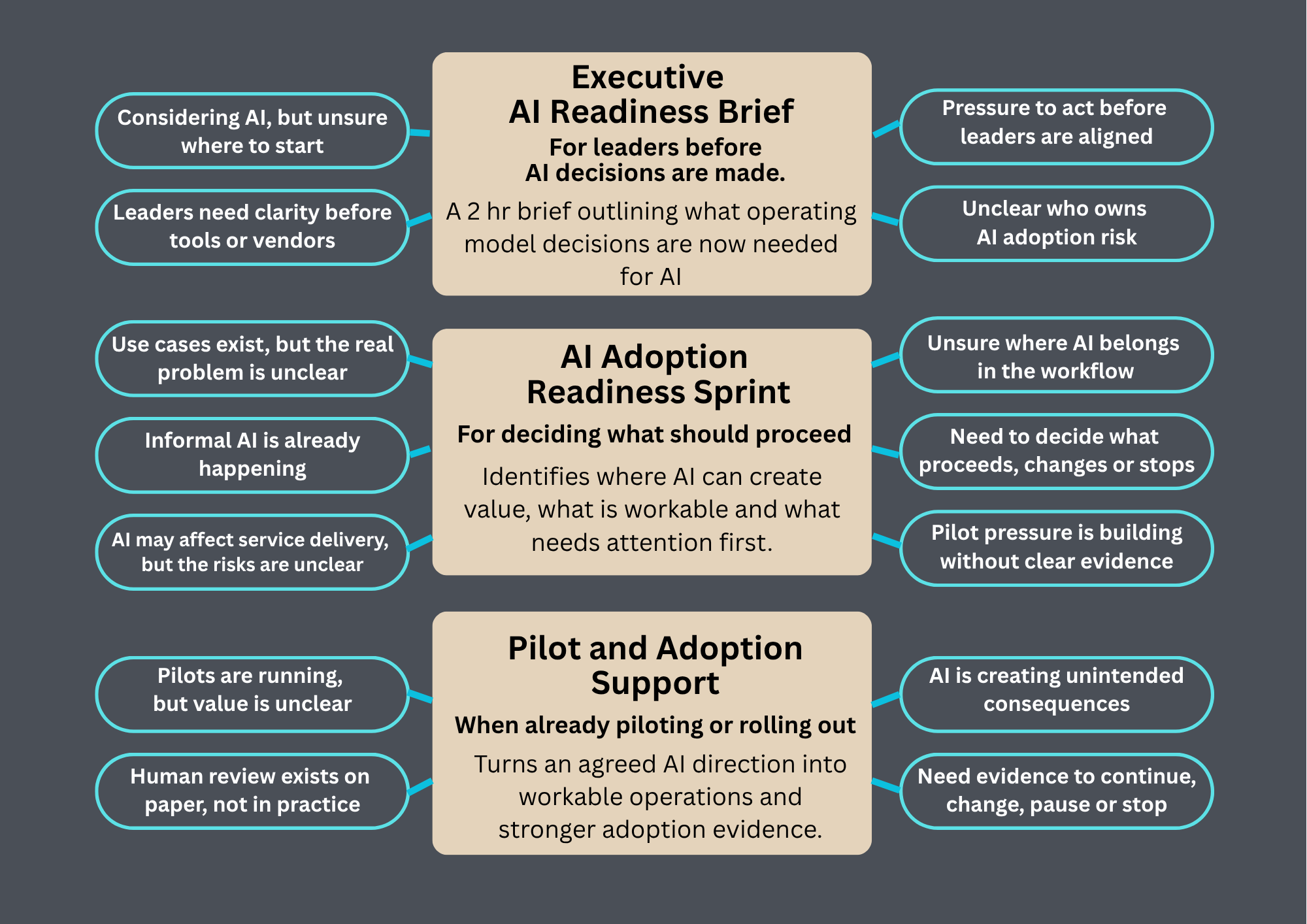
Each service addresses a different issue or point in the adoption cycle. You can start with the service that matches where you are now, and use one service or combine support where your needs span more than one stage.
Executive AI Readiness Brief
A focused 2-hour session for leaders before major AI decisions are made.
The Brief helps executives understand where AI may create value and what it changes across operating models, governance, accountability, service delivery, human control, data exposure and operating cost.
It is useful when leaders are considering AI, facing pressure to act or need clearer judgement before committing to tools, vendors, pilots, training or rollout.
The objective is to give leaders a stronger basis for deciding where to focus attention and what needs to be understood before activity moves forward.
AI Adoption Readiness Sprint
A structured, hands-on process for organisations that need a clear direction for AI adoption.
The Sprint helps identify where AI can create meaningful operational value, determine what is workable under current conditions, establish where the data involved would travel and which parties would hold it, test whether that value justifies the cost against the best realistic alternative, and focus effort on opportunities that can realistically move forward.
The work examines real operational problems, workflow fit, feasibility, governance and accountability so leaders can make stronger adoption decisions and direct investment and organisational effort more effectively.
The outcome is a clearer basis for deciding where AI belongs, what needs to be addressed to make adoption workable and what should move forward.
Pilot and Adoption Support
Pilot and Adoption Support is for organisations moving from an AI decision into pilot, implementation or wider adoption, as well as organisations that need to strengthen activity already underway.
It helps turn an agreed AI direction into workable operating conditions, strengthen pilots, test whether expected value continues to justify the cost as adoption moves toward scale, confirm that the data arrangements accepted at pilot still hold at production volume, and build the evidence needed to expand what is working.
Support may include workflow design, role and human oversight clarity, pilot preparation, adoption monitoring and addressing operational or governance issues that are limiting value.
Where activity is not performing as expected, the evidence can also support informed decisions about what to strengthen, change, pause or stop.
Good controls are not there to slow adoption down. They help organisations move forward with greater confidence because responsibilities, boundaries and ways of responding to problems are clear.
AI Capability & Workforce Uplift
Workforce capability uplift can sit alongside any stage of adoption.
This includes modular AI Accelerator development for executives, managers and teams, and targeted, tool-specific workforce uplift aligned to the work, responsibilities and decisions AI is changing — typically building on the Accelerator's foundations, with relevant modules folded directly into the rollout where that fits the engagement better.
The focus is practical. People need to understand how to use, manage and supervise AI in the context of the work they are actually responsible for.
Capability should strengthen adoption rather than sit alongside it as a disconnected training activity.
What you gain
- clearer direction on where AI can create practical value
- stronger focus for investment and organisational effort
- better alignment between AI and real operational work
- workable operating conditions for selected AI activity
- clearer human review points, responsibilities and accountability
- stronger pilots and better evidence about what is working
- earlier visibility of issues that could undermine value
- better control over informal AI use and unmanaged workarounds
- clearer workforce and capability requirements
- greater confidence about what to strengthen, expand, change, pause or stop
Where to start
The right entry point depends on where AI activity currently sits.
You may be exploring opportunities, preparing a pilot, moving into implementation or trying to improve activity that is not delivering the expected value.
The first step is to clarify where the strongest opportunity sits, what is getting in the way and what support will help move it forward.