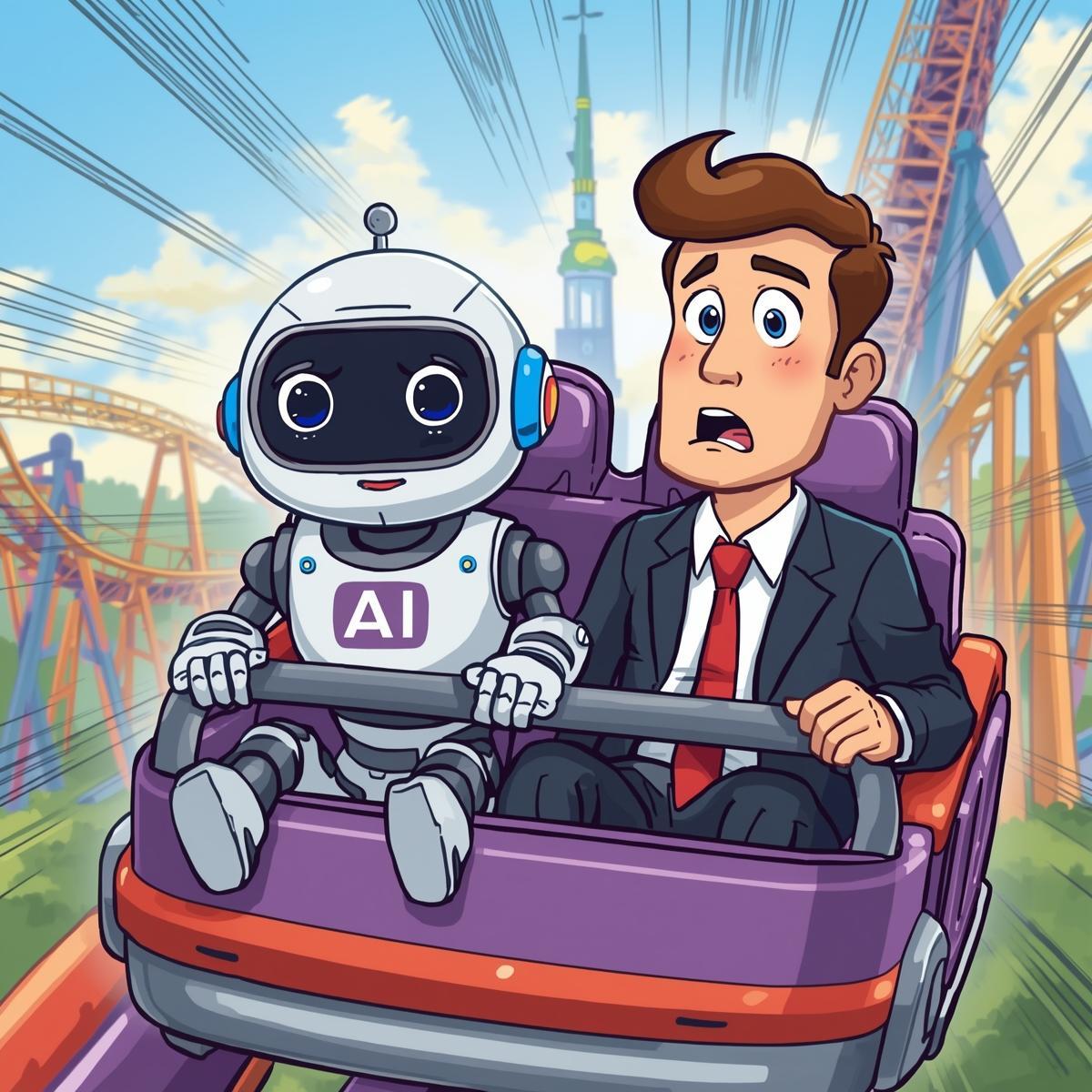
Across the companies I speak with, the pattern is consistent.
Some teams use AI brilliantly. Others stall after the pilot phase.
The difference isn’t the technology itself. It’s how clearly people define the problem, prepare their data, and build the right habits around it.
Where AI Is Working
Let’s start with the outliers. The ones doing it well.
- Developers using GitHub Copilot are coding up to 55 percent faster.
- The UK payments firm Allpay reports 10 percent productivity growth and 25 percent more output.
- L’Oréal uses GPT-based tools for copywriting and translation, cutting production cycles by 60 percent and lifting engagement by 35 percent.
- Canva’s Magic tools have powered over a billion AI actions, cutting design time by more than half.
These aren’t lucky results. They come from clarity, clean data, and skilled teams.
When the foundations are strong, AI accelerates value creation instead of adding noise.
Fully and semi-agentic systems are now starting to act, not just assist.
They monitor pipelines, triage customer service requests, reconcile accounts, and rebalance inventory, escalating to humans only when judgment is needed.
Still, these results remain the exception. Most organisations are wrestling with data, governance, and workflow maturity. The real transformation begins when readiness becomes mainstream.
Where It’s Falling Short
Despite rapid adoption, the broader impact remains limited. Economists call it a technology maturity lag, often shaped like a J-curve. Early performance dips as teams adapt, then rises sharply once alignment and maturity take hold. Most organisations today are still in that trough, learning what works and what doesn’t.
When computers first arrived, people used them as faster typewriters. The real leap came when they connected to the internet, when information and transactions moved online.
AI is at the same stage.
Many organisations are using it to perform old tasks faster, swapping Google for ChatGPT to search or summarise. Useful, yes. Transformative, no.
Real value comes later, when organisations reimagine processes with AI, not around it. That means clean, connected data, structured workflows, and leaders who understand where AI fits and where it doesn’t.
Those who rush in unprepared often learn the hard way.
The Commonwealth Bank of Australia rolled out an AI voice-bot, cut staff, and saw service quality collapse. Complaints spiked. The project was rolled back.
Automation without readiness doesn’t remove inefficiency. It amplifies it.
The Trust Problem
Trust remains the single biggest barrier to scaling AI.
Large language models generate confident, fluent answers even when they’re wrong. They’re not built to reason, only to predict the next word. Worse, they’re trained to avoid admitting uncertainty.
When Deloitte Australia delivered a $440,000 government report full of fabricated case law, it made national headlines. The AI didn’t “lie.” It did what it was trained to do: sound convincing. That confidence cost Deloitte Australia its credibility.
It’s a blunt reminder. Human oversight isn’t optional. It’s essential.
Hallucinations, bias, and data quality issues still plague even advanced systems. Until governance and verification catch up, trust will remain the chokepoint.
The Turning Point
AI is now shifting from prediction to discovery.
Startups like Periodic Labs are leading the charge with autonomous laboratories that use AI-guided robots to conduct real-world experiments, discovering new superconductors, catalysts, and compounds that could reshape clean energy and medicine.
Instead of simply reading about materials, AI-guided systems are testing them, learning through action, not simulation.
This marks a turning point. Every industry that relies on experimentation, from manufacturing to pharmaceuticals, is watching closely.
AI is no longer just predicting; it’s beginning to act. And when human insight meets machine autonomy, the potential multiplies.
The Big Picture
Zoom out and a pattern emerges.
First comes the hype.
Then the disillusionment.
Then the real progress, when capability meets readiness.
That’s where we are now. The hard-knocks phase, where optimism meets reality.
AI isn’t failing. It’s testing how ready we are.
It won’t fix broken systems. It will expose them.
It won’t replace good judgment. It will reward it.
The next few years won’t be defined by who uses AI first, but by who uses it wisely.
Where AI Is Headed
The next phase of AI won’t be defined by bigger models, but by smarter integration.
Semi-agentic systems will handle more operational tasks, quietly streamlining workflows. The winners will be those who’ve already invested in clean data, governance, and skills.
As generative AI matures, the differentiator will shift from access to ability: the human skill to define problems clearly, prompt precisely, and sense when automation crosses ethical or contextual lines.
Agentic AI will expand what’s possible, but the real advantage will remain human: structured thinking, context awareness, and collaboration.
The organisations that treat AI as a partner, not a shortcut, will lead the next wave.
Moving From Hype to Readiness
At Future CoLab 3000, I help organisations move from hype to clarity with two practical offerings:
- AI Readiness Assessments – pinpointing value, risk, and capability gaps before investing in any solution.
- AI Education and Capability Uplift – teaching teams the AI mindset and skills to work effectively and safely with AI.
Because AI isn’t the problem.
Clarity is.
And most organisations still don’t have enough of it.