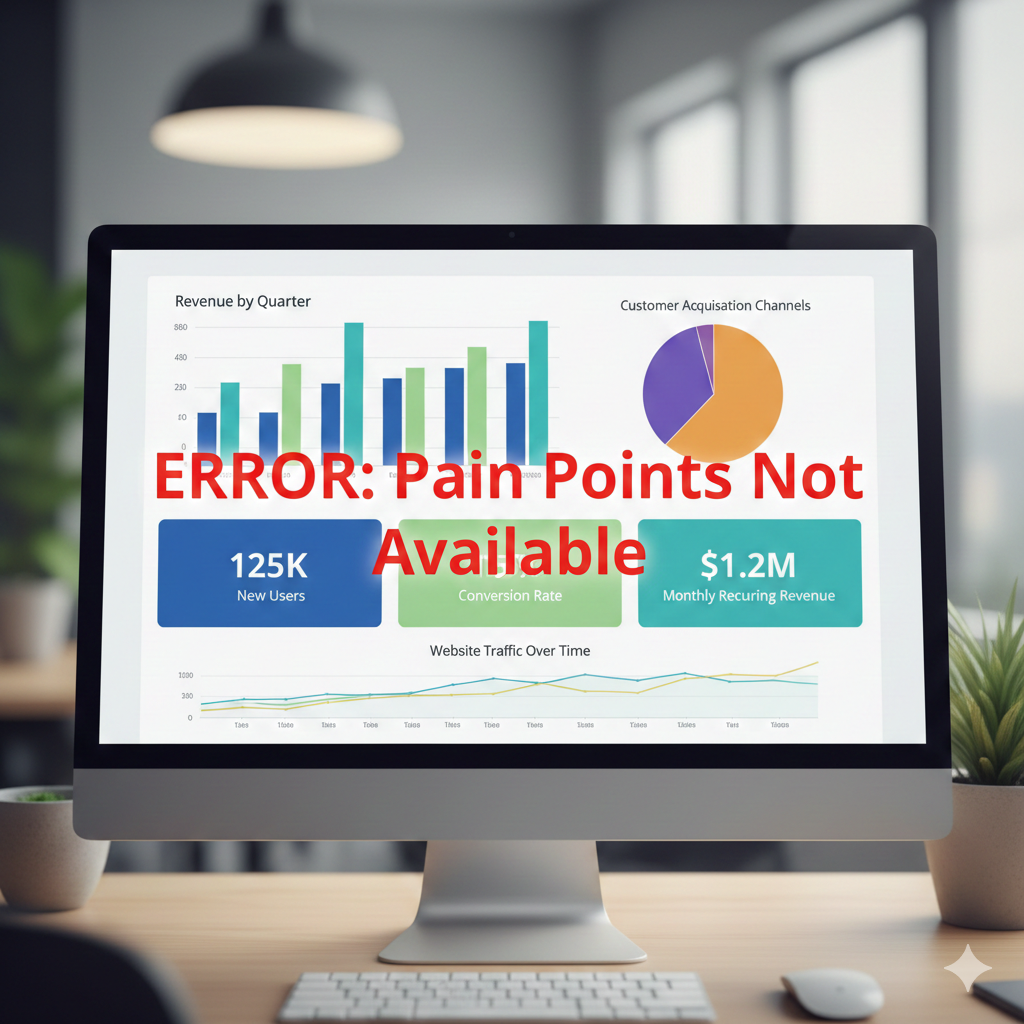
The Assumption That Breaks the Model
The assumption behind auto-diagnosis is simple:
If enough data exists in business systems, AI can analyse it and identify operational friction.
But here’s the problem.
In most small and medium enterprises — and even in many large organisations — the data required to diagnose real business pain simply does not exist in structured form.
Operational pain points are rarely logged in systems.
They live in:
- People’s heads
- Informal workarounds
- Conversations
- Tribal knowledge
- “The way we actually do things”
AI can analyse structured data.
It cannot analyse undocumented context.
If the work hasn’t been clearly defined, documented and modelled, there is nothing for AI to optimise.
AI Accelerates Processes. It Does Not Discover Them.
Today’s AI tools are powerful at:
- Generating reports
- Drafting documents
- Triaging communications
- Automating repetitive tasks
- Optimising structured workflows
But there is a fundamental difference between accelerating a defined process and discovering a broken one.
Auto-diagnosing workflow inefficiencies assumes:
- Clean historical data
- Clear process boundaries
- Consistent system usage
- Documented exceptions
- Structured definitions of success and failure
Most organisations do not have this level of process maturity.
Instead, what exists is partial documentation, informal workarounds, hidden dependencies and tacit decision-making.
That is not a dataset.
That is human context.
The Real Barrier to AI Adoption
This is why many AI initiatives stall.
The issue is rarely the sophistication of the technology.
The issue is readiness.
Before meaningful automation can occur, organisations need:
- Human-led discovery
- Structured workflow mapping
- Clear articulation of pain points
- Data hygiene
- Agreement on how work is actually performed
Without this foundation, AI is being asked to optimise noise.
And optimisation of noise simply produces faster confusion.
Why This Matters for SMEs and Large Organisations
For SMEs, the gap is often obvious:
Systems are fragmented. Documentation is light. Processes evolve organically.
For larger organisations, the illusion is more dangerous:
Dashboards exist. Data lakes exist. Automation pilots exist.
But if real operational friction lives outside the systems — in people’s informal knowledge — AI will not surface it automatically.
You cannot automate tribal knowledge.
You must extract it first.
What Leaders Should Do Instead
If your ambition is meaningful AI-enabled workflow transformation, the sequence matters:
- Run structured discovery.
- Surface tacit knowledge through workshops and interviews.
- Map real workflows, including exceptions and informal steps.
- Clean and structure the data that reflects those workflows.
- Only then apply AI to accelerate and optimise.
AI is not a substitute for business analysis.
It is an amplifier of it.
The Context Gap
AI technology is evolving rapidly.
But the discipline required to capture how work actually happens is evolving more slowly.
That gap - between technological capability and organisational readiness - is where most AI strategies quietly fail.
The future of AI in business is not autonomous discovery.
It is intelligent amplification of clearly defined work.
And defining the work still requires people.
If you’d like to assess whether your organisation is ready for AI-enabled workflow automation, start by asking a simple question:
Can we clearly describe how work actually happens today — without looking at a system?
If the answer is no, that’s where the real work begins.